

{{item.Subject}}
Auction News
Learn about events, happenings and more
Just how much do EVs depreciate? We crunched the numbers ...
Tuesday, 11 August 2026 | James Coleman
Buy a brand-new smartphone, fast forward two years, and you could take the bet to the bank that it'll be worth about half what you paid for it. Sandwiches depreciate faster, when left outside in the rain.
So it’s fair to assume a modern EV - which is basically a giant iPhone on wheels - suffers the same steep drop, right?
Not quite.
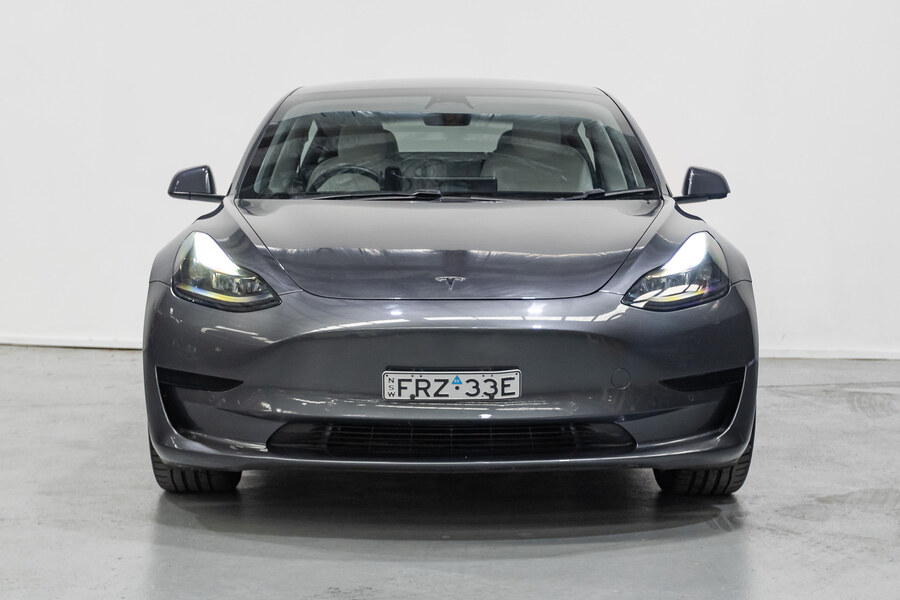
We recently listed a 2022 Tesla Model 3 on CARBIDS Canberra with just 33,156 km on the clock. When a brand-new Model 3 starts around $54,900, going the used route is seriously tempting - especially if someone else has already swallowed the worst depreciation by driving it off the showroom floor.
So, how does the used EV market actually stack up in Australia right now? We busted out the calculator ...
What's demand like for used EVs?
The Australian car market recorded its strongest July ever this year, with 103,656 new vehicles delivered, according to the Federal Chamber of Automotive Industries (FCAI). EVs accounted for a massive 21.7% of this, making up one-fifth of the entire new car market for the second month in a row.
Yet, used EVs still only make up a tiny 1.5% of all used-car sales, according to a November 2025 report by the Australian Automotive Dealer Association (AADA).
There simply aren't any buyers: only 12% of used-car shoppers are actively looking for an EV, compared to 26% in the new market.
Tesla dominates the second-hand battery market with a 32.6% market share, with the Model 3 and Model Y alone driving nearly a third of all used EV sales.
Hesitation mostly comes down to two things: fear of looming expensive battery replacements, and uncertainty around resale values.
But, how well-founded are these?
How much value do EVs really hold?
To see if EVs really do plummet off a cliff, we'll look at Retained Value (RV) - the percentage of original price a car keeps over time. Across all Australian used cars, the national weighted average RV sits right around 63.1% (that's an aggregate figure for used vehicles younger than 15 years).
According to the AADA, a 1-year-old EV retains 78.1% of its original value, a 2-year-old EV retains 61.5%, and a 3-year-old EV retains 55.5%.
In other words, a 2-year-old EV retains value at virtually the same rate as the overall SUV segment (61.7%) and sits just a fraction behind broader passenger cars (62.5%).
So yes, EVs do depreciate faster than traditional petrol models - and certainly faster than something like a Toyota RAV4 - but the gap is slim, not the catastrophic piano-falling-off-a-cliff crash internet comments might suggest.
What about the battery?
About 32% of people told the AADA they were unlikely to buy an EV cite due to the fact "costs of repair are too high" - in other words, they didn't want to be stuck with a a dead or dying battery.
But not only has this figure dropped from 36% in late 2024, the reality is far different.
Most manufacturers cover batteries with an 8-to-10-year (or 160,000 km) warranty guaranteeing at least 70% capacity. Beyond that, real-world data shows EV battery packs typically last 15 to 20 years (or 450,000 to 800,000 km) before they pass the 70% point.
So, in short, the rest of the car is far more likely to wear out first.
The verdict
There's good and bad news going forward.
The EV market overall is stabilizing as charging infrastructure - a primary barrier for 43% of buyers - continues to slowly improve.
And while the AADA found 27% of people were concerned about future resale value, another 27% of the general population believes now is a good time to buy an EV - specifically because they expect them to hold their value.
About the only drag is a looming road-user charge (RUC), which is expected to put off about 27% of EV buyers. But by the same token, "20% say a distance-based RUC would make them more willing to buy an EV", AADA reports.
As more and more EVs pour into the new market, there'll be a flow-on effect for the used market too - along with a stronger base to form a truer depreciation rate, in turn, building buyer confidence.
Your best bet for now? One from a proven brand, like Tesla ...
|
|