

{{item.Subject}}
Auction News
Learn about events, happenings and more
This 1913 car owner's manual makes for entertaining reading today
Wednesday, 25 November 2026 | James Coleman
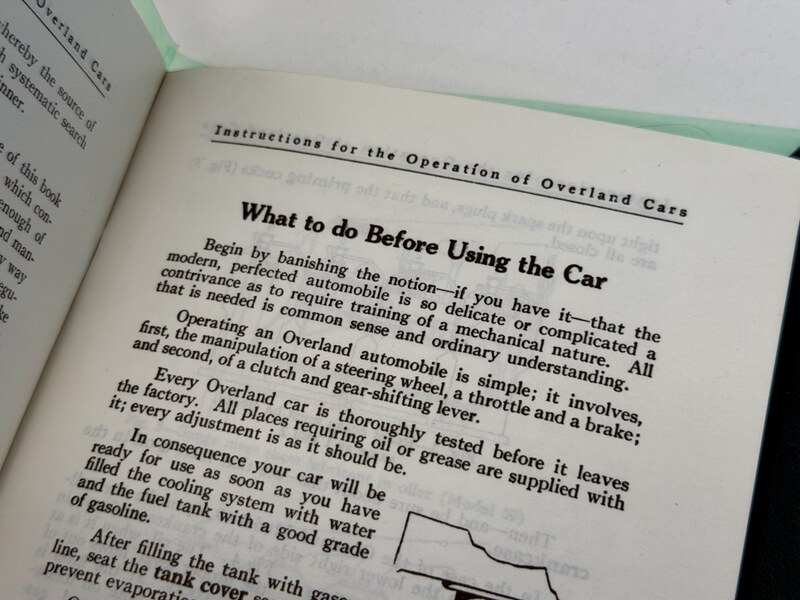
Whenever you buy a new car, it is almost social law that you must leaf through the owner's manual that very night in bed.
In fact, it could be the the one exception men make when it comes to reading instructions.
But no matter who you are, this one deserves to be read cover to cover.
In 1913, driving was still a novel, slightly alarming idea. So the Willys-Overland Company of Toledo, Ohio, felt it had some reassuring to do, and a few opinions to share.
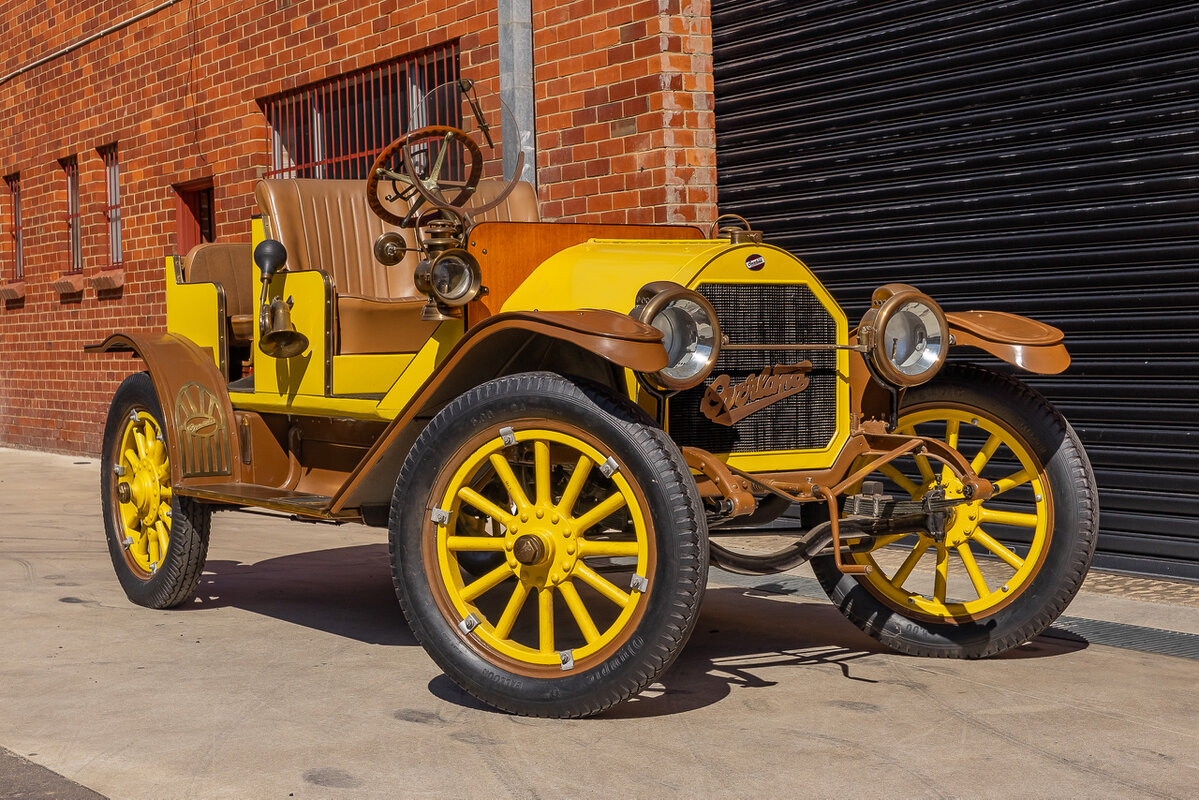
The 1913 Willys-Overland is online now.
Its "Instruction Book for the Operation, Care and Adjustment of Overland Automobiles" comes with a 1913 Willys-Overland Model 69 Touring in CARBIDS' Vintage Automobiles and Heritage Design auction, closing Thursday 3 December.
It's a book that would have been lost for history, except this car's owner kept meticulous records, digging up mechanical information, diagrams and specification sheets that would be impossible to find anywhere else today.
And 113 years on, it makes for some entertaining reading.
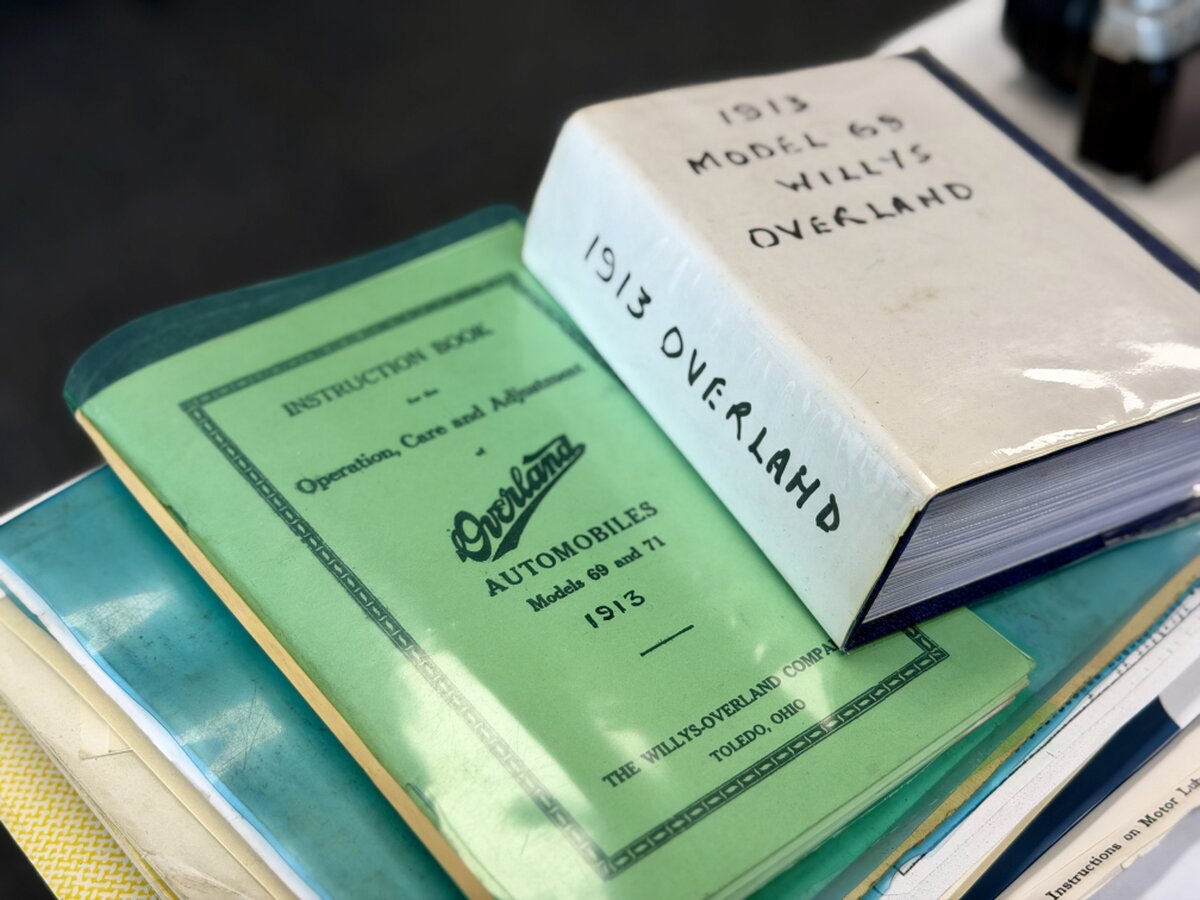
Just some of the documents that come with the car.
Less work than a horse
The book starts by calming the nerves.
"Begin by banishing the notion – if you have it – that the modern, perfected automobile is so delicate or complicated a contrivance as to require training of a mechanical nature," it says.
"All that is needed is common sense and ordinary understanding."
Driving, it explains, simply involves a steering wheel, a throttle, a brake, a clutch and a gear-shifting lever. Peering into the open-air cockpit of the Willys-Overland today, simple isn't exactly the word that comes to mind.
And the three-step process to start it confirms this, starting by hand-cranking it with a handle mounted into the front.
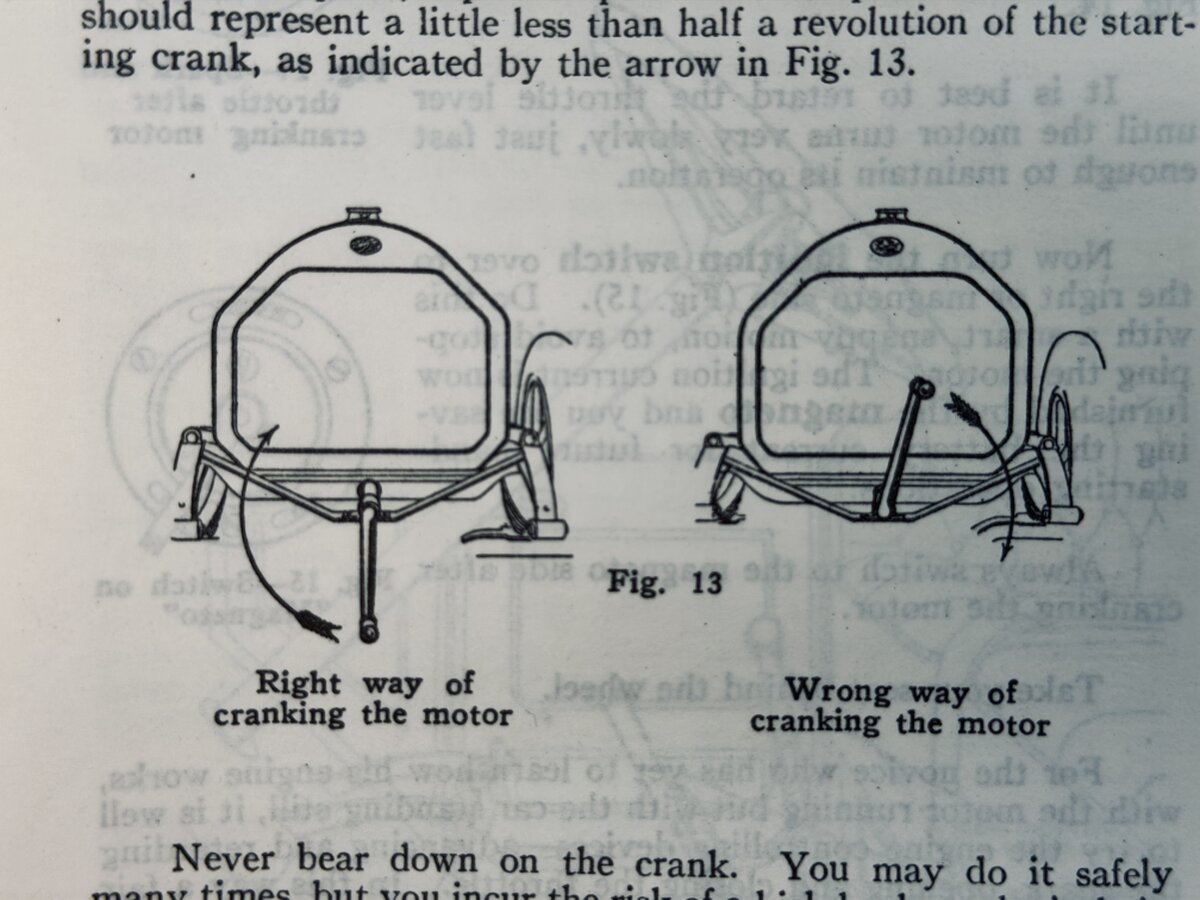
Well before the push button.
The book goes on, with instructions on how to change gears, and most importantly stop.
"It is well to bear in mind here that the ability to bring the car quickly to a stop is occasionally of greater importance than facility in starting it."
With everything properly adjusted and oiled, the Overland needs "only a very small fraction of the attention that would be absolutely necessary for the care of a horse."
Some owners, it notes, are said to have "luck" with their car's reliability. Luck has nothing to do with it.
"By neglecting details you will save a few moments in getting on your way; but the day of reckoning is sure to come ... It is attention to the 'little things' that counts."
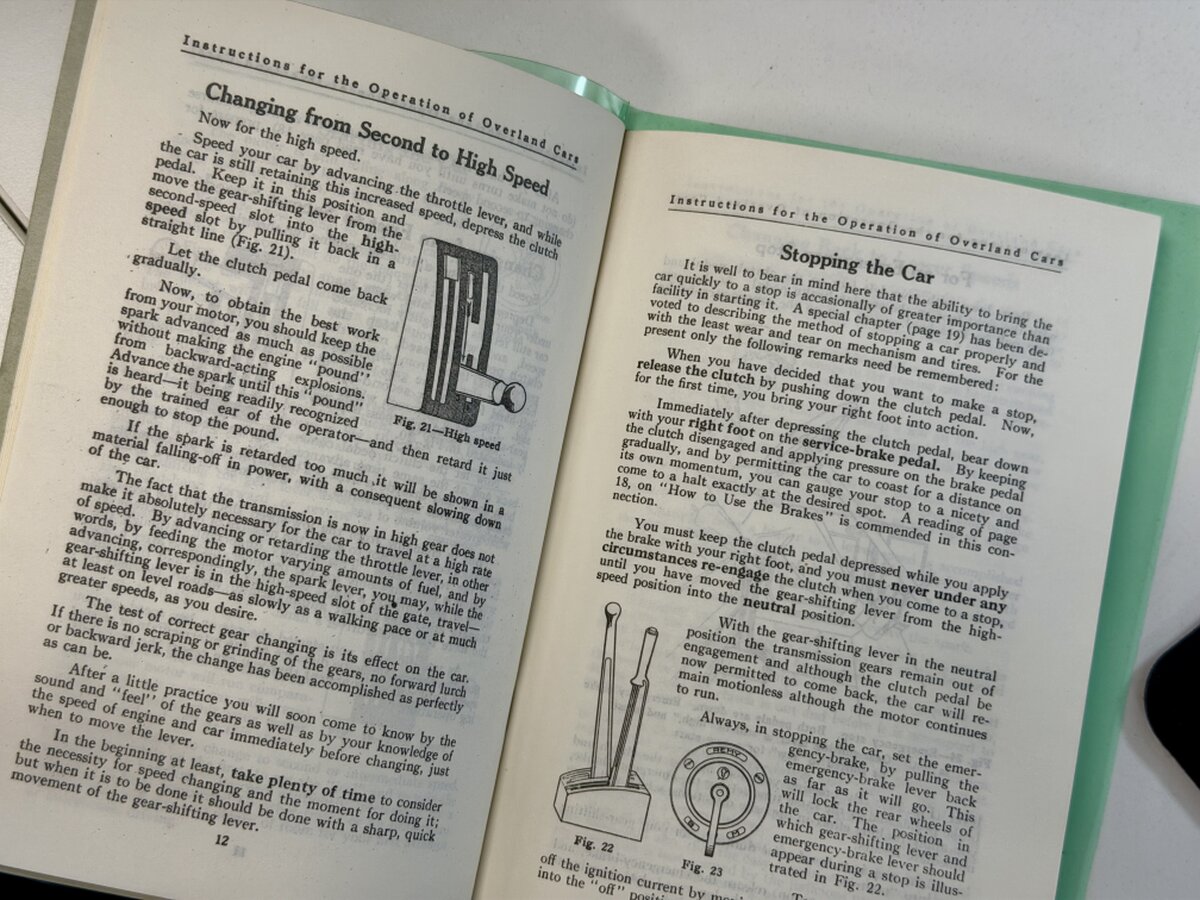
No synchromesh here.
No showing off
The book has some firm views on driving style, too.
The Overland's steering is "irreversible", meaning the car would hold a straight line with nobody touching the wheel. Tempting? The book isn't having it.
"Keep your hands on the steering wheel at all times, and no harm will befall you from collision with some unexpected obstruction."
It warns against hooning: "Nothing is more severe on a car than the spectacular stopping often indulged in by ignorant drivers, in an effort to 'show off'.
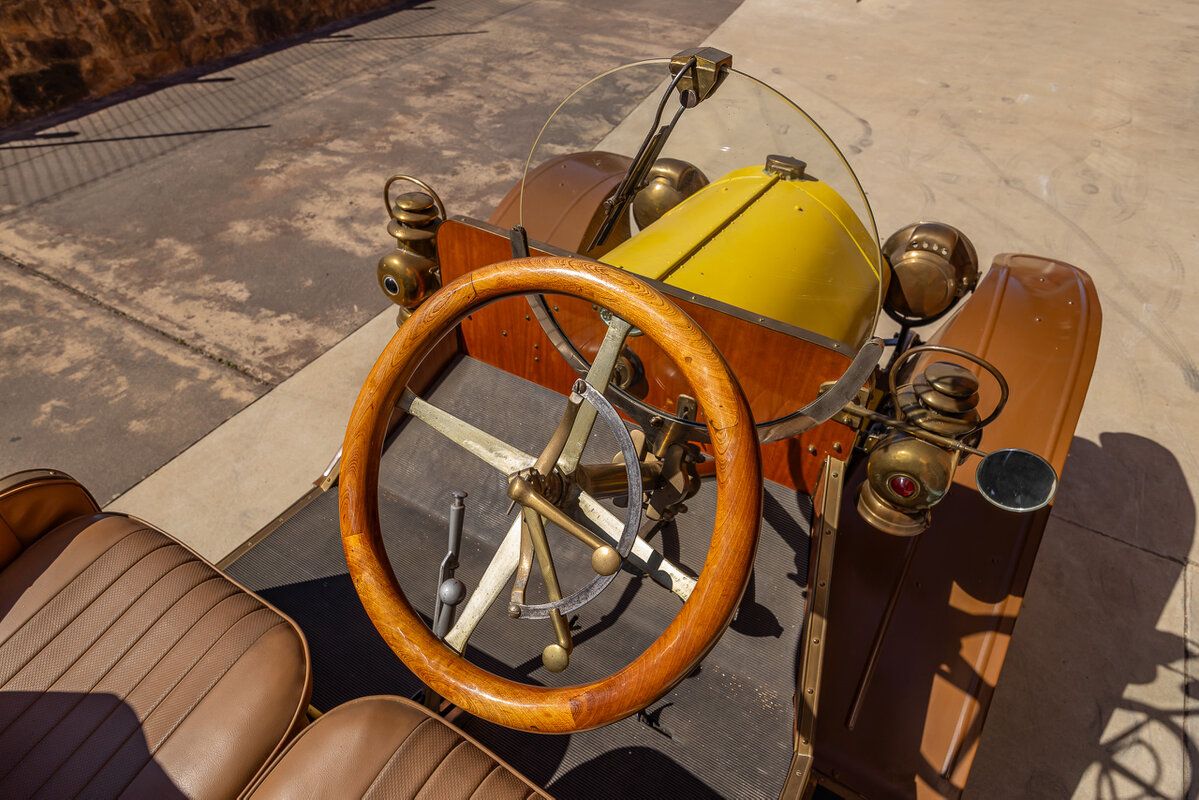
Not exactly a simple operation.
And describes "excessive use of the horn" as "proof that the motorist is a novice".
It also reminds novices that in the United States, the rule is to keep to the right.
"Motorists are law-abiding as a class and none but the reckless will refuse or neglect to pay obedience to the rules."
Curiously, though, like all Overlands built before 1915, this one is right-hand drive.
One reminder many would still welcome today: "It is likewise a mere courtesy ... that one traveler shall not hold the road to the exclusion of other travelers, but shall turn whenever possible, to permit the vehicle following to pass".
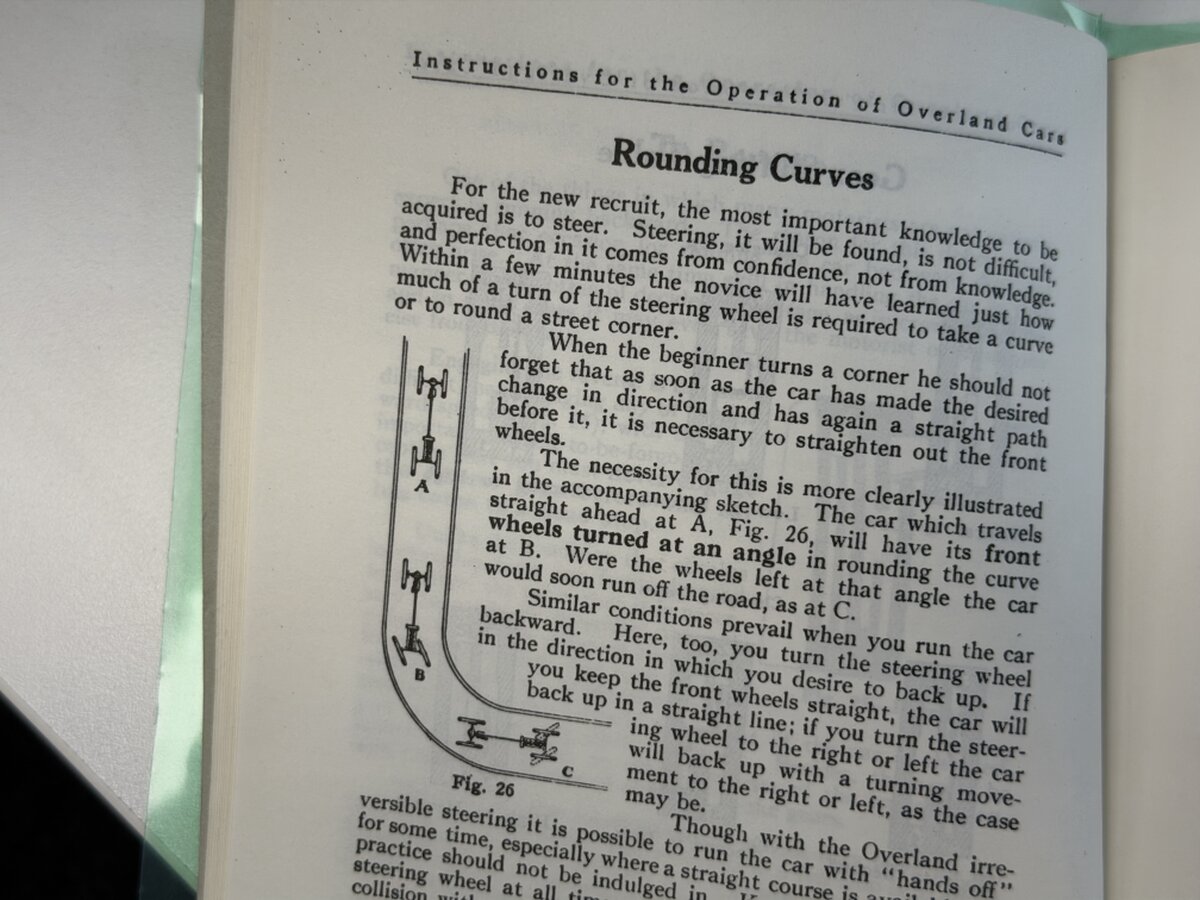
How to go around corners - probably not something you'd see in a modern manual.
Second only to Ford
The book's confidence was well earned.
Overland began in 1903 in Terre Haute, Indiana, and was nearly broke by 1907, when car dealer John North Willys, who'd paid a deposit on 500 Overlands, came looking for them and ended up taking over.
He moved it to Toledo, and from 1912 to 1918 Willys-Overland was America's second-biggest carmaker, behind only Ford. It would later build the Second World War Jeep, and today's Jeep Grand Cherokee Overland is named in its honour.
This Model 69 has a 3.7-litre four-cylinder engine rated at 25.6hp, a three-speed manual and no electrics.
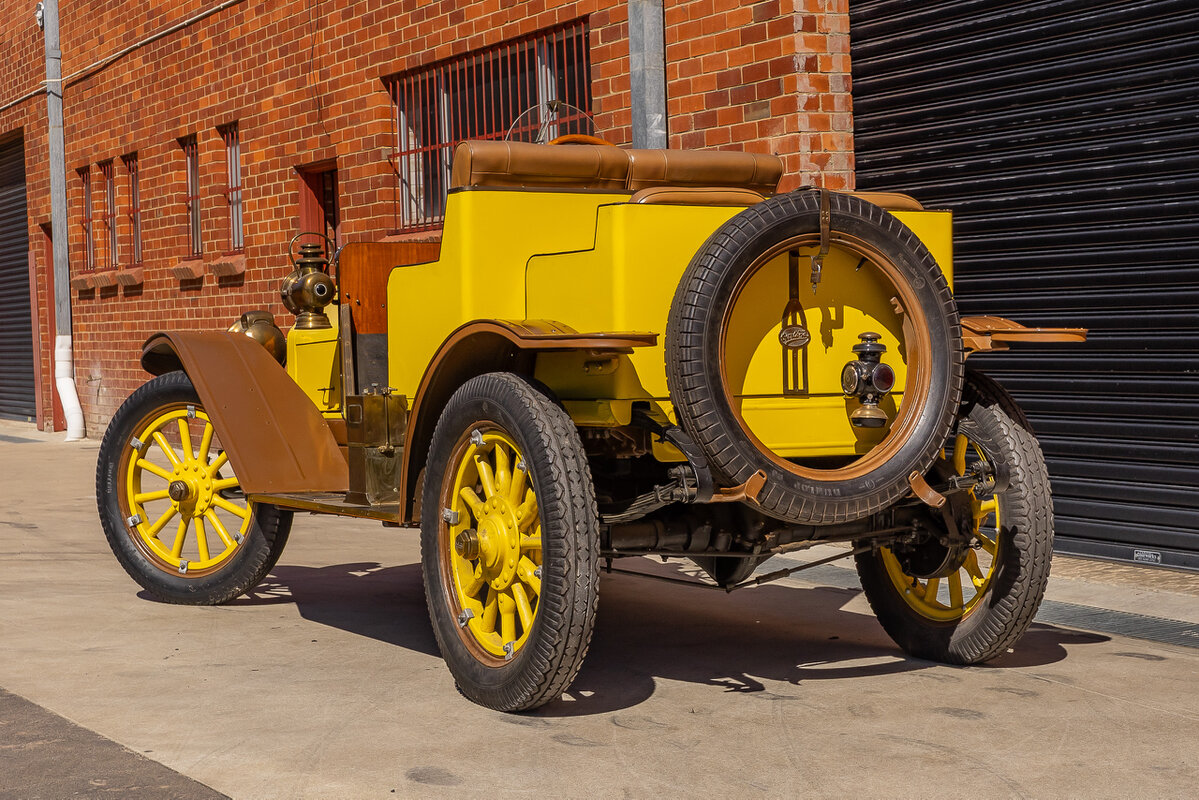
The Willys-Overland was restored from several wrecks over decades.
Its owner restored it over several decades in his Narrabundah garage, sourcing parts from all over the country, and it's now finished in striking yellow with brown seats. The archive that comes with it includes restoration photos and notes, specification sheets, and yes, a copy of the original owner's manual.
It's one of eight cars in the sale, alongside a 1926 Buick once traded for a bottle of whisky, a 1934 Rover that did a Crookwell doctor's rounds and a 118-year-old French La Buire racing car.
"This is a first for CARBIDS," says ALLBIDS Group CEO Ben Hastings.
"We've sold a lot of classics over the years, but never cars from this far back."
All eight are on display now at the ALLBIDS Showroom, 7 Wiluna Street, Fyshwick, with lots closing from 7:05pm AEDT on Thursday 3 December.
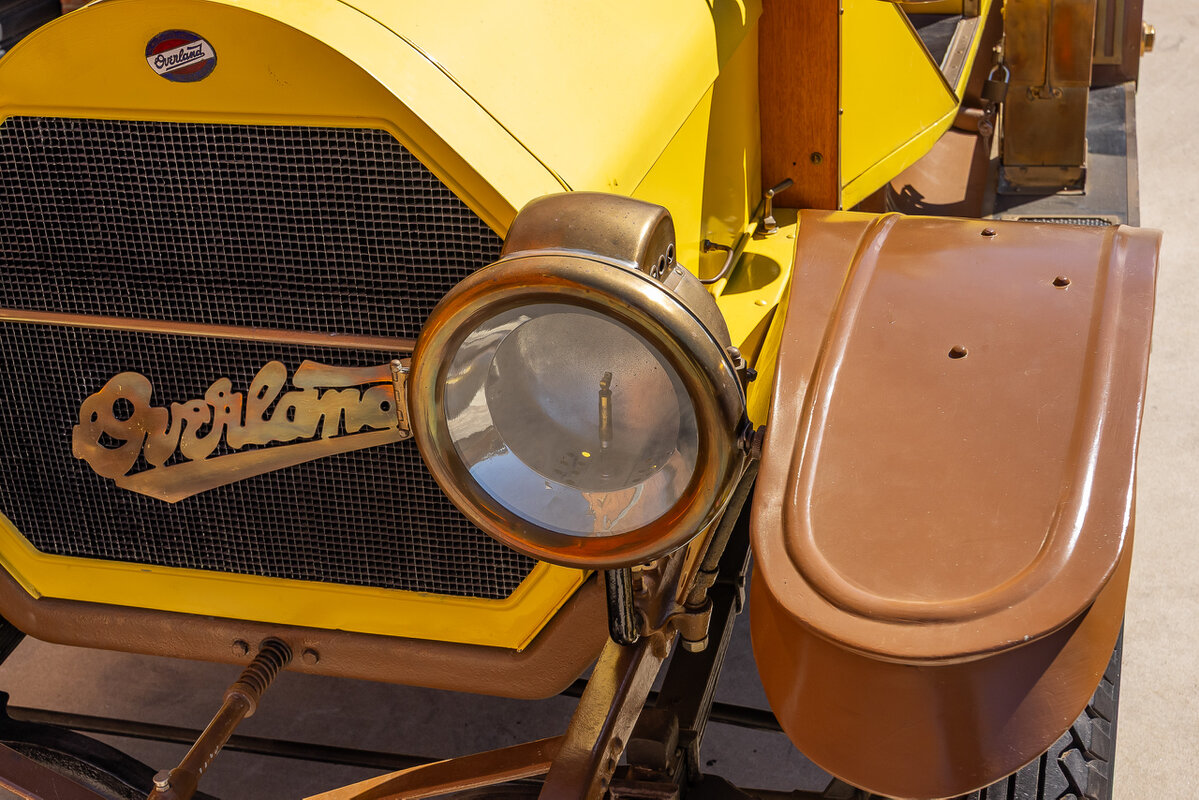
Where today's Jeep Grand Cherokee Overland gets its name from.
View the Vintage Automobiles and Heritage Design auction
|
|